
Word-by-Word Captions vs Full-Sentence Captions in 2026
Word-by-word captions dominate viral TikTok and Reels; full-sentence wins for dense content. Engagement data and cognitive science explain when to use each.


The choice between word-by-word captions and full-sentence captions is the choice that defines what your short-form video feels like at the moment of viewing. Word-by-word (karaoke) captions create a visual pulse that moves with speech. Full-sentence captions give viewers a complete thought to read before it disappears.
In 2026, word-by-word has become the default for most short-form social content. But the story is more nuanced than "karaoke always wins." This guide covers what each format does, the data on which performs better and in what contexts, and the practical decision of which to use for your specific content.
Definitions
Word-by-word (karaoke) captions: Each individual word, or a short cluster of 2–3 words, appears or highlights in sync with the moment it is spoken. In the most common form — the "karaoke" style — a highlight color moves across words sequentially as the speaker talks. The viewer reads at speech pace rather than ahead of it.
Full-sentence captions: A complete sentence or phrase (typically 8–15 words) appears as a static block for its entire duration, then is replaced by the next sentence. The viewer can read the full thought at once, ahead of or alongside the speaker's delivery.
Both are animated in the sense that text changes between frames. The distinction is granularity: word-level vs. sentence-level timing.
The State of the Format in 2026
Word-by-word is the dominant format across high-performing short-form content. The evidence:
- OpusClip's analysis of 13.5 million TikTok clips (Q1 2026): the overwhelming majority of viral-tier content uses short-burst animated captions (word-by-word or 2–3 word phrases). Full-sentence static blocks are associated with lower-performing content in the corpus.
- The "Hormozi style" — 1–3 words per frame, ALL CAPS, Montserrat Bold or equivalent, with a highlighted emphasis word — became the dominant short-form caption approach from approximately 2022 and has maintained that position through 2026.
- Every major caption tool in the market (CapCut, Submagic, BlitzCut, Captions.ai, Opus Clip) uses word-by-word as the primary output mode and treats full-sentence as the secondary or accessibility-focused option.
Creator community consensus on Reddit (r/TikTokCreators, r/NewTubers) and YouTube tutorial channels is strongly pro-word-by-word, though it is anecdotal — no creator has published a controlled A/B test with statistically significant results.
Why Word-by-Word Is Theorized to Outperform
The Attention-Guiding Mechanism
Each word appearing in sequence creates a moving focal point. The human eye naturally tracks motion. When the caption word appears, the eye snaps to it — even in a passive scroll environment. Full-sentence blocks don't have this: the eye scans the block once and has no subsequent reason to return to it.
In a 60-second video with a viewer's thumb hovering on the "swipe" gesture, the word-by-word motion creates continuous micro-moments of visual engagement that keep the thumb still.
Pacing as a Cognitive Tool
Word-by-word captions pace the viewer's reading at exactly the speed of speech. This removes a common friction with full-sentence captions: the viewer reads the full sentence in 1.5 seconds but the sentence stays on screen for 4 seconds, creating a gap where there is nothing new to read. This pause in information delivery is a drop-off risk.
With word-by-word captions, there is no information gap. Each word is new content. The caption track stays in motion continuously.
Emphasis Through Isolation
When three words appear at a time, the middle word is the emphasis word. When a single word highlights against its neighbors, it becomes the visual emphasis of the phrase. Full-sentence captions have no equivalent mechanism — all words are visually equal in a sentence block, so nothing is visually emphasized.
The Hormozi yellow-highlight technique uses this principle deliberately: one word per phrase changes color, creating an automatic visual hierarchy that guides what the viewer processes as the key idea.
The Data: Confidence Levels
| Claim | Source | Confidence |
|---|---|---|
| Word-by-word dominant in viral TikTok content | OpusClip 13.5M clip analysis | Medium (vendor data, large n) |
| ~15% engagement lift for word-by-word on educational content | Vendor claims (multiple tools) | Low (no published methodology) |
| Captions of any kind: 80% more likely to watch to completion | Verizon/Publicis 2019, n=5,616 | High |
| Attention-guiding via moving focal point | Cognitive science basis solid | Medium-High (indirect research) |
| Creator community strongly prefers word-by-word | Reddit/creator consensus | Medium (anecdotal, strong consensus) |
The honest summary: Word-by-word captions outperform full-sentence captions in short-form social video for most content types, with strong theoretical backing and consistent observational data, but without a published controlled experiment isolating caption format as the single variable.
When Full-Sentence Captions Win
The "word-by-word always wins" framing is wrong for specific content types:
Dense, Technical, or Analytical Content
When viewers need to parse a full logical statement — a multi-part argument, a technical explanation, a data interpretation — breaking it into word-by-word fragments actually hurts comprehension. The viewer needs the complete sentence in view simultaneously to process the logical relationship between its parts.
Example: "The 2026 inflation figure, which excludes food and energy, shows a deceleration relative to the previous quarter" — broken into word-by-word, this is nearly incomprehensible. As a sentence block, it is readable.
Slow-Paced, Meditative, or Narrative Content
For content that deliberately moves slowly — ambient video, nature footage with narration, storytelling — word-by-word animation introduces a visual rhythm that conflicts with the pacing. Static blocks or slow fade-in effects match the energy better.
Compliance and Accessibility Requirements
Pre-burned word-by-word captions cannot be toggled off by the viewer. They do not satisfy accessibility compliance standards that require toggleable closed captions (Section 508, WCAG 1.2). For organizational content with legal accessibility obligations, static SRT files uploaded as toggleable closed caption tracks are required.
Long-Form Platform Content
YouTube long-form videos (10+ minutes) use static SRT captions as the standard. Word-by-word animation in a 45-minute video would be visually exhausting. The format is specific to short-form — 15–90 second clips where the continuous motion maintains engagement at the compression level short-form requires.
The Practical Format Decision
For most talking-head creators on TikTok, Reels, and YouTube Shorts:
Use word-by-word (karaoke) captions when:
- Video is 15–90 seconds
- Content is motivational, educational, opinion-based, or talking-head
- Your speech pace is 130–180 words per minute (normal conversation)
- You are optimizing for completion rate and engagement metrics
- Captions are replacing the audio experience for muted viewers
Use full-sentence captions when:
- Content is analytically dense or contains multi-part logical arguments
- Accessibility compliance (toggleable captions) is required
- You need cross-platform translation via native platform tools
- Video is long-form (10+ minutes) where continuous animation creates fatigue
- Content is slow-paced or meditative in tone
Words Per Caption Unit: The Middle Ground
Between pure single-word captions and full sentences, there is a practical middle ground: 2–5 word phrases.
- 1 word per frame: Maximum emphasis, suitable for hype and high-energy content. Can feel fragmentary for longer sentences.
- 2–3 words per frame: The Hormozi-style default. Maintains speech rhythm, allows for one emphasis word per frame, natural for most talking-head content.
- 4–5 words per frame: Works for faster speech or for content where 2-3 word bursts feel choppy. Still short enough to maintain the pacing advantage over full sentences.
- 6+ words per frame: Approaches full-sentence behavior. The pacing advantage over static blocks shrinks.
The 2–3 word range is the sweet spot for most creators in 2026.
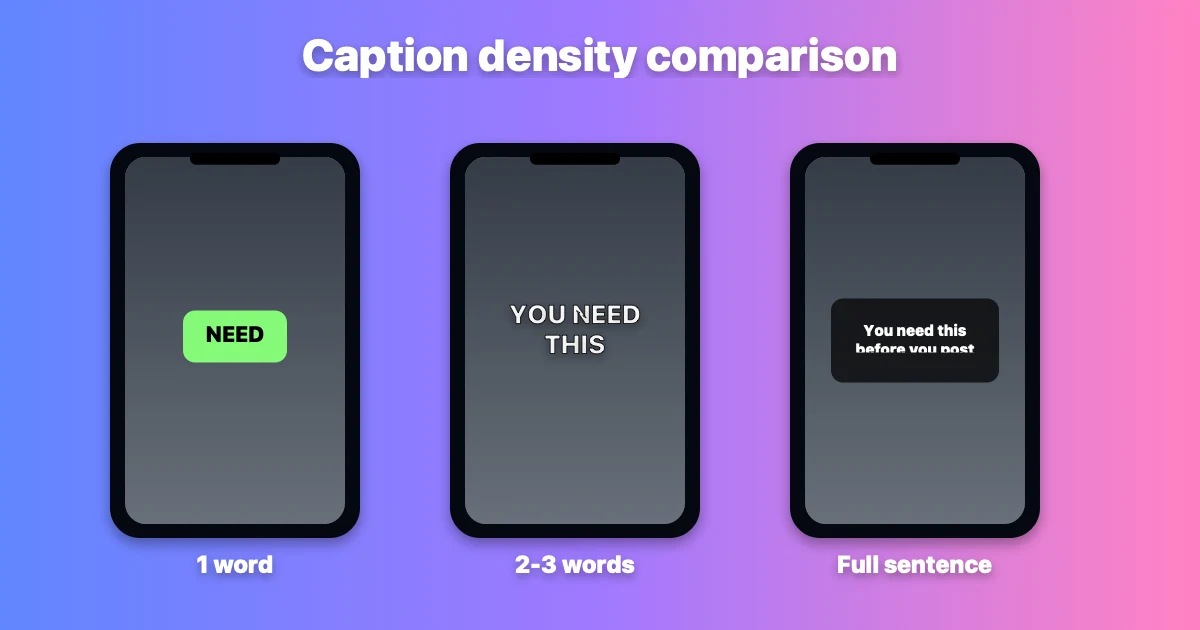
1-word (maximum emphasis, left), 2–3 word Hormozi-style (center), and full sentence (right) on the same frame. The 2–3 word range keeps speech rhythm intact while preserving emphasis on a single key word per unit.
How Word-by-Word Captions Are Generated
The practical challenge with word-by-word captions is timing accuracy. Each word must appear at precisely the moment it is spoken — not a half-second early or late. This requires word-level timestamp data from the transcription engine, not just sentence-level timestamps.
Tools that generate word-by-word captions:
- BlitzCut (Mac): Transcript-based workflow — the full transcript is generated first, edited for accuracy, then captions are generated with word-level timing from the transcript. The karaoke style applies word-by-word highlighting automatically.
- CapCut: AI auto-captions with multiple animated style presets. Available on iOS, Android, and desktop.
- Submagic: Browser-based, claims 98.9% transcription accuracy, 100+ caption style presets including multiple Hormozi variants.
- Captions.ai: iOS-primary tool, word-by-word animated captions with filler word removal.
The production advantage of transcript-based generation (BlitzCut) versus direct-audio generation: corrections made to the transcript carry through to caption timing automatically. In tools that generate captions directly from audio, correcting a mis-transcribed word requires manually adjusting that word's timing in a separate step.
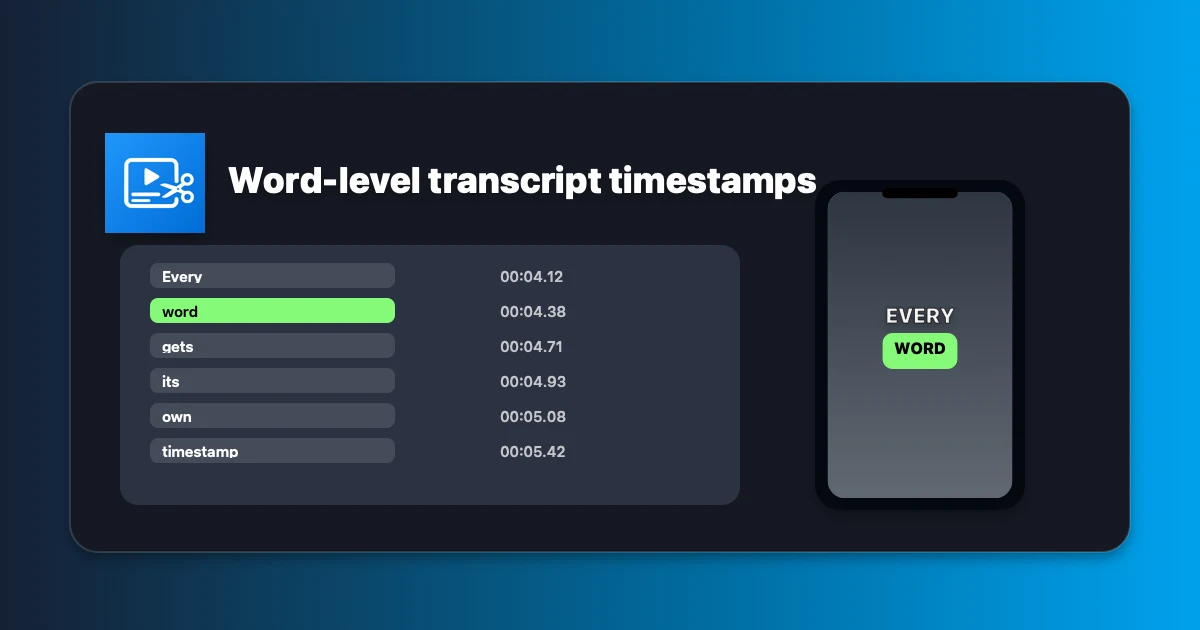
BlitzCut's transcript panel. Every word has an individual timestamp — this is what drives word-level caption timing. Edit a word here and the caption timing updates automatically on export.
Caption Editing: The Correction Workflow Difference
A practical comparison of how errors are corrected in each approach:
Full-sentence static captions (SRT): Error correction happens at the sentence level — find the incorrect block, edit the text. Timing of other words in the block is unaffected.
Word-by-word captions (direct audio generation): Find the incorrectly transcribed word. Correct the text. Manually re-sync the timing for that word if the correction changes character count significantly.
Word-by-word captions (transcript-based, as in BlitzCut): Edit the transcript word. The corrected word is used when captions are generated — timing is re-derived from the corrected transcript. No separate timing step.
For creators who produce captions at volume and have transcription errors (technical terms, proper nouns, brand names), the correction workflow difference is meaningful at scale.
Frequently Asked Questions
Are word-by-word captions better than full-sentence captions? For short-form social content (TikTok, Reels, Shorts): yes, in most cases. Word-by-word captions guide attention, eliminate reading-pace gaps, and match the visual energy of short-form video. For dense analytical content, long-form video, or content requiring accessibility compliance: full-sentence static captions can outperform.
What is a karaoke caption? A karaoke caption is a word-by-word animated caption where a highlight color moves across words in sequence as they are spoken — the same visual pattern as karaoke song lyrics. The color highlight guides the viewer's eye to the currently spoken word.
How many words should appear at once in TikTok captions? 2–3 words per frame is the most common and recommended default. Single words work for maximum emphasis in hype content. 4–5 words work for faster speech or more complex sentences. More than 6 words approaches the behavior of full-sentence captions.
Do word-by-word captions improve TikTok watch time? The evidence is directional but not from a published controlled experiment. Vendor data from OpusClip (13.5M clips) shows correlation between word-by-word captions and viral performance. Cognitive science supports the mechanism. Creator consensus strongly favors word-by-word for completion rate. Treat "15% engagement lift" claims as directional estimates, not verified measurements.
Can I use word-by-word captions on YouTube long-form videos? Technically yes, but it is not standard practice and may create visual fatigue over a 20+ minute video. YouTube long-form uses static SRT captions as the default format. Word-by-word animated captions are production standard for short-form (under 3 minutes).
Related: Animated Captions vs Static Captions · TikTok Caption Trends 2026 · Karaoke Captions on Mac
Post every day without spending hours editing
BlitzCut is a native app for iPhone, iPad, and Mac. Get from raw footage to TikTok-ready in under 2 minutes, so editing is never the reason you didn't post.
Try it for freeRelated Articles
Keep Reading

Best Adobe Premiere Rush Alternatives (2026): Where to Go Before It Shuts Down
Premiere Rush support ends September 30, 2026. The best alternatives for Mac, iPhone and Android — including Adobe's own replacement — and how to migrate.

Best AI Clipping Tools, Rated by What Users Actually Say (2026)
Best AI clipping tools compared on independent user reviews, billing complaints, and pricing: Vizard, OpusClip, Klap, Quso, and BlitzReels. Plus OpusClip alternatives.

Best AI Video Editor for iPhone (2026): 8 Apps Ranked
The best AI video editor for iPhone and iOS in 2026: 8 apps ranked by captions, silence removal, speed, and price for TikTok, Reels, and Shorts.